
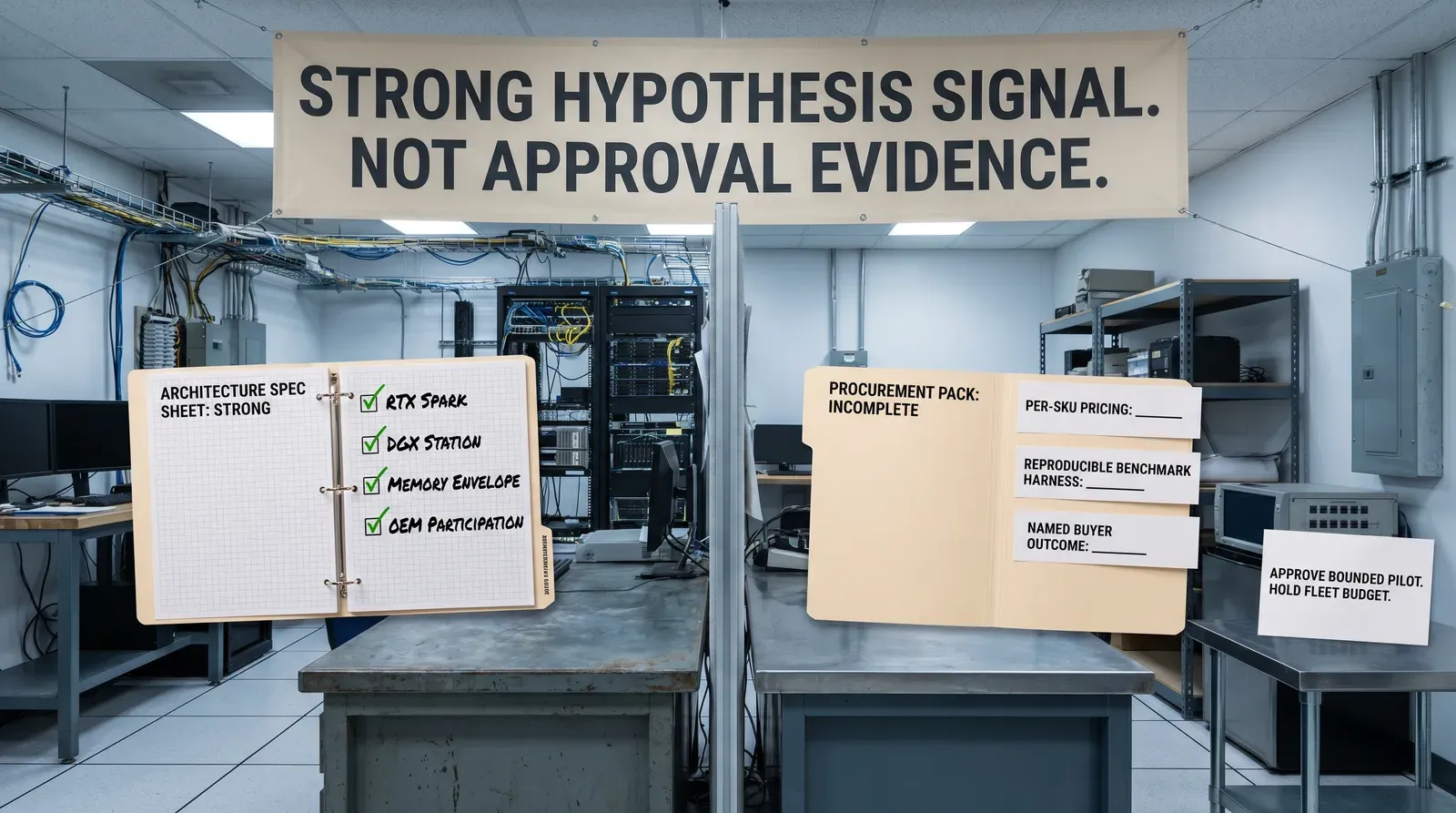
NVIDIA Has the Specs. Buyers Still Need the Procurement Pack
NVIDIA's RTX Spark and DGX Station launches are strong architecture signals, but enterprise funding decisions still require pricing, reproducible benchmark disclosure, and named buyer outcomes.
Quick decision summary
Five plain-language checks for a go or hold decision
- What claim are we testing?
- NVIDIA launch disclosures for RTX Spark and DGX Station are sufficient evidence to approve enterprise-scale endpoint and deskside AI budget this cycle.
- Who is the named peer?
- NVIDIA and Microsoft launch disclosures, 2026-05-31. No named enterprise buyer post-rollout outcome on record in the source set.
- Source strength
- T2 T2 (vendor-controlled disclosure or secondary coverage)
- Where this may not apply
- The evidence is mostly launch-stage provider disclosure. It supports technical direction and platform intent, but does not yet prove deployment economics or post-rollout operating outcomes for regulated enterprise environments.
- Recommended decision
- Cite this as hypothesis evidence for a gated pilot only. Do not approve fleet-scale budget until per-SKU economics, reproducible benchmark method, and one named enterprise post-rollout outcome are disclosed.
NVIDIA has the strongest architecture narrative in this cycle. That is not the same as having ready for buying decisions evidence.
Editorial status
Publish-ready as a strong thesis post with no buyer proof yet. Ship with explicit disclosure that named buyer evidence is still missing, then revisit on the trigger below.
No-buyer-proof disclosure
This article ships as thesis guidance, not as buyer-validated deployment proof.
- Buyer-proof status: no named T1 buyer post-rollout metric found as of
buyerProofLastSearchedAt. - Reader caveat: use this for pilot-gate design, not for fleet-scale budget release.
- Revision trigger: revise when one named enterprise buyer publishes before-and-after outcomes on this launch class.
- Downgrade trigger: if no named buyer proof appears by 2026-08-31, downgrade
statustohypeor archive.
The launch cluster is clear. On May 31, NVIDIA and Microsoft framed RTX Spark systems as a new Windows PC class for local AI agents and creator workloads. The same window introduced DGX Station for Windows as a deskside enterprise AI compute path. For a delivery owner, this is real signal on direction. It is not yet enough to defend fleet-level spend.
What this launch does prove
The launch proves three things credibly.
- Platform direction is real. NVIDIA and Microsoft are converging on a local-plus-enterprise compute stack rather than a cloud-only default.
- Technical envelope is explicit. The disclosures name architecture class, memory envelope, and positioning for both endpoint and deskside pathways.
- Ecosystem coordination is visible. OEM participation and partner alignment are clear in first-party materials.
That is strong strategy evidence.
What it does not prove
The launch does not prove that this quarter is the right moment for broad budget release.
- No ready for buying decisions per-SKU economics are disclosed in this source set.
- No reproducible benchmark harness is published for the workloads enterprise buyers actually fund.
- No named enterprise buyer is on record with before-and-after operating outcomes tied to these exact launch claims.
Without those three, this remains launch-quality evidence, not deployment-quality proof.
Pass 1 vs Pass 2 reading
Pass 1 says the new hardware class is here and enterprises should move now.
Pass 2 says the architecture is promising, but a funding decision still needs evidence that can survive finance and operations review. The difference is not enthusiasm. The difference is decision quality.
What would count as real evidence
Any one of these would move this read materially. All three would move it to compelling.
- Public per-SKU pricing and enterprise support terms for the relevant rollout configurations.
- Reproducible benchmark method for the named workload classes, with software versions and test protocol.
- One named enterprise post-rollout outcome with before-and-after metrics on cost-to-serve, throughput, or customer-facing functionality.
Draft-stage upgrade path (bounded)
To keep this draft compelling in draft-stage, collect one procurement-grade buyer-evidence packet before publish lock.
- Source to fetch next: named enterprise infrastructure or platform leader discussing RTX Spark or DGX deskside deployment.
- Quote type required: one verbatim quote that separates architecture promise from buying threshold.
- Metric required: one before-and-after operating metric tied to throughput, latency, or unit economics.
- Owner and deadline: evidence packet captured in weekly scan notes before publish-stage review.
If this packet is still missing at the downgrade trigger date, reclassify to hype or archive rather than leaving the thesis unlabeled.
Decision line for the next funding meeting
Treat NVIDIA’s RTX Spark and DGX Station launch as a strong hypothesis signal, not as approval evidence for fleet-scale spend. Approve a bounded pilot with pre-declared gates. Hold full budget release until pricing, benchmark method, and named buyer outcomes are publicly disclosed.