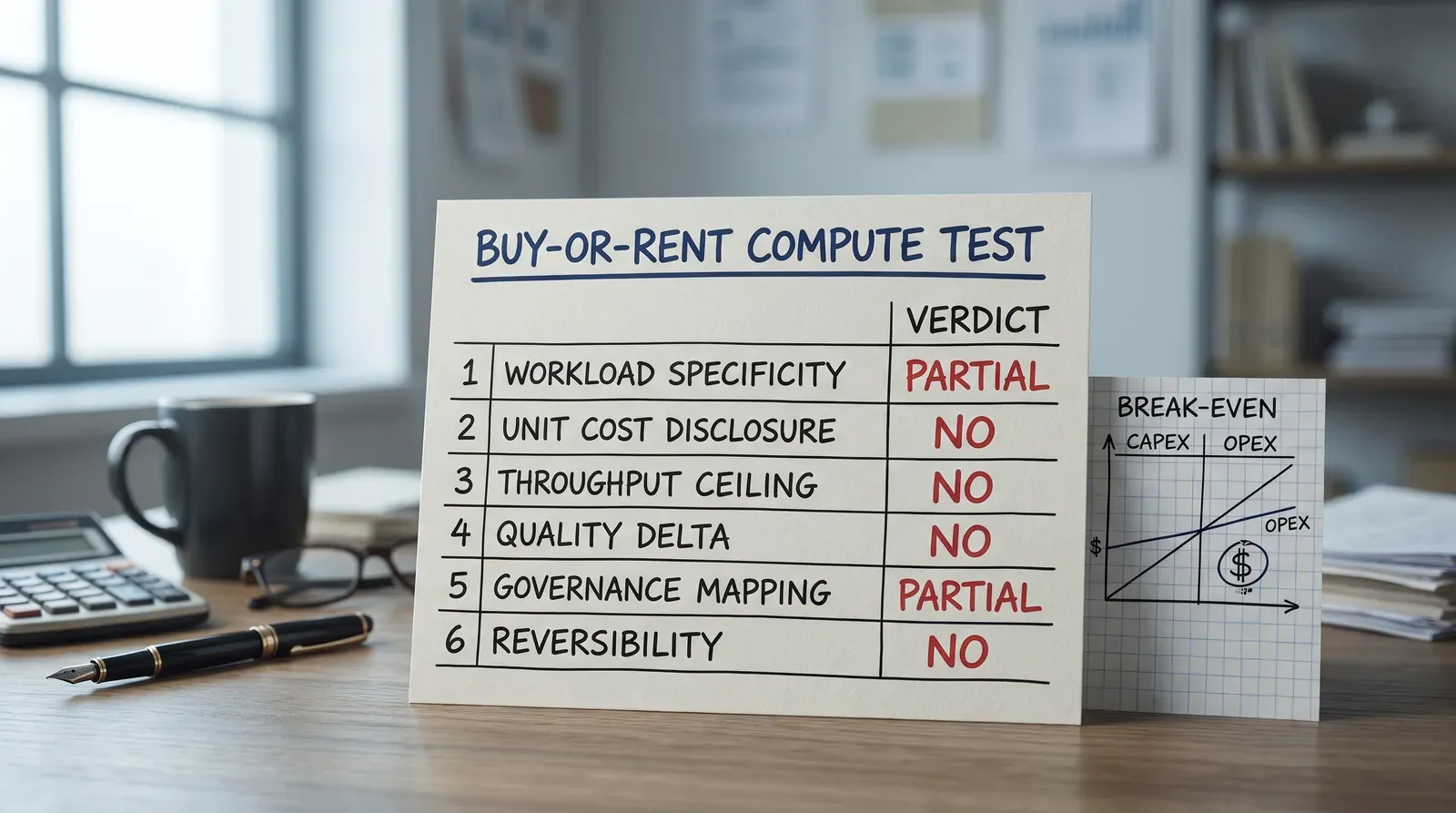
Buy-or-Rent Compute
When vendors pitch capex-for-opex AI substitution, six tests decide whether the math actually works.
What this lens looks for
Vendor announcements that pitch a capex purchase (local-inference PCs, deskside supercomputers, on-prem GPU clusters, sovereign AI appliances) as a substitution for opex spend on cloud LLM APIs. The capex-for-opex pitch is real economics. It is also where vendors hide the most assumptions. This lens forces the substitution claim through six tests before the verdict lands.
The six tests
Each test is scored yes / partial / no against the vendor’s actual public disclosure, not against the pitch deck or the keynote.
1. Workload class specificity. Are two or more specific workload classes named (developer coding assistant, RAG over private documents, batch agent runs), or is the pitch “AI workloads” in the abstract? Vague workload framing is the first tell.
2. Unit-cost disclosure on both sides. Is the cost per workload-unit disclosed for the local class AND for the cloud comparator being displaced? Dollars per thousand-token-equivalent, dollars per code suggestion, dollars per RAG query, with methodology. A substitution claim with one side disclosed is half a claim.
3. Throughput ceiling honesty. At what concurrent-user or queries-per-second threshold does the local hardware saturate and cloud burst become required? “Unmetered intelligence” rhetoric fails this test by construction.
4. Quality delta named per workload. For each named workload class, is the quality gap versus the cloud incumbent disclosed (same model, smaller model, different model entirely), ideally with a public benchmark that meets the standards the publication has previously enforced in the methodology lens?
5. Governance and lifecycle mapping. For regulated buyers, does the local class map to the same compliance posture as the cloud service it replaces (BAA, FedRAMP, residency, sovereign cloud)? Patch cadence, end-of-life, and security model disclosed?
6. Reversibility named. Capex is sunk in a way opex is not. What is the salvage path at twenty-four or thirty-six months if substitution fails? Resale value, repurposability, residual fleet utility? Vendors will not volunteer this; the absence is the verdict.
When we apply it
- A vendor announces hardware as a cost-reduction play against cloud AI spend
- A buyer is being asked to fund a fleet refresh or new deskside class on a capex-for-opex thesis
- Any “local AI”, “sovereign AI”, or “AI factory” pitch where the substitution math is implied rather than shown
What the verdict looks like
Articles through this lens display the six-test scorecard for the specific announcement, name the tests passed and failed, and convert the result into a Funding Meeting Brief decision line. The decision line names the conditions that would flip the verdict, so the article remains useful as disclosure lands or fails to land.
Why the lens exists
The publication’s other lenses ask whether a claim has buyer evidence. This lens asks something narrower: whether the math underneath a vendor pitch holds up before any buyer evidence exists. Capex-for-opex substitution is one of the few AI funding theses where a buyer can model the answer in advance with public inputs. When the inputs are missing, the lens makes the gap visible.
Falsification
This lens is failing if articles tagged with it cluster around “no” on all six tests for a sustained run of three or more pieces, or if a published scorecard turns out to misread a public disclosure. The first pattern suggests the lens is fishing; the second triggers a correction. Revisit by 2026-12-01 against the count of pieces shipped under this tag.