
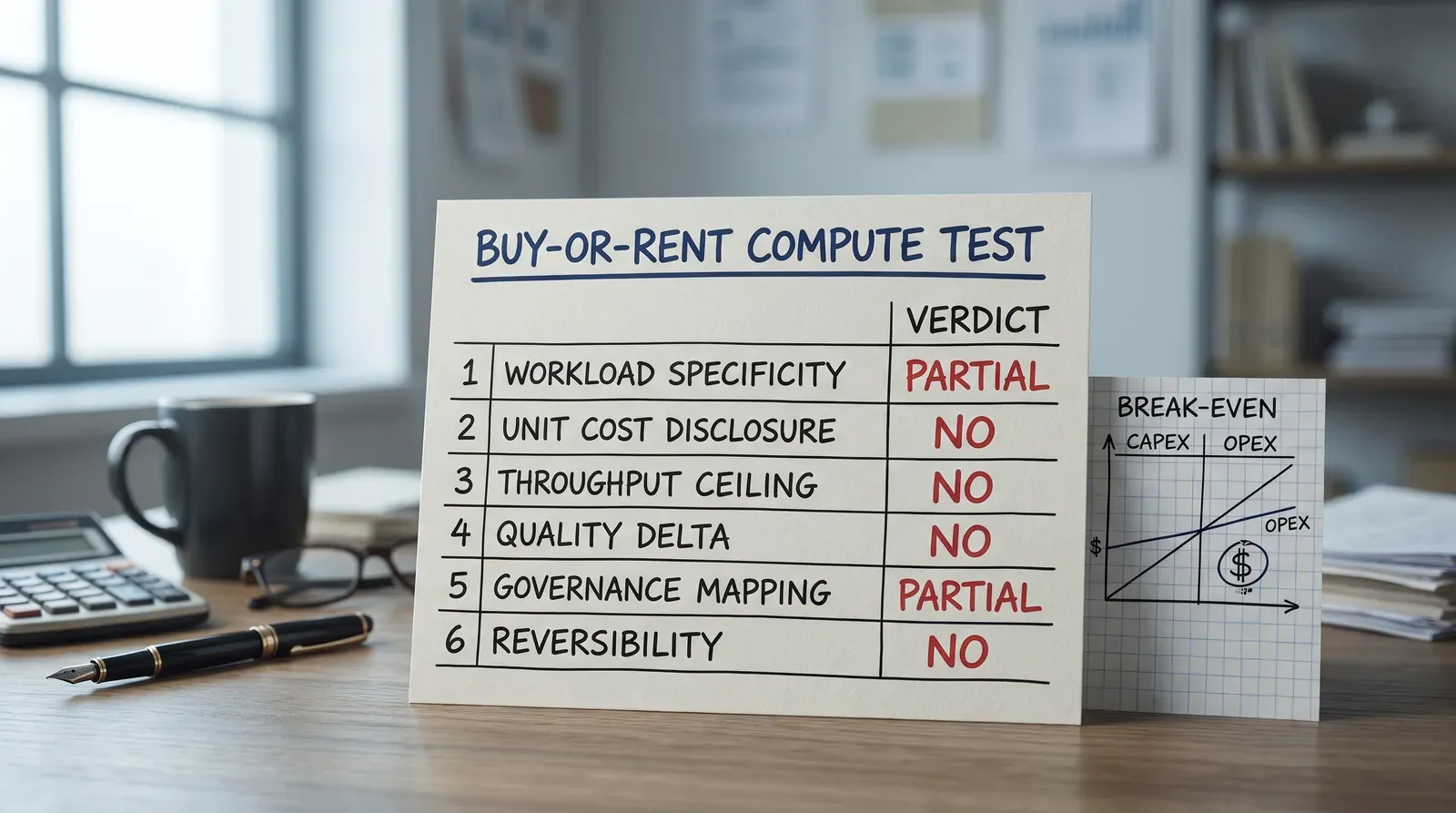
The Buy-or-Rent Compute Test. A New Standing Rubric, Applied to the Microsoft + NVIDIA Launch
This living article introduces the Buy-or-Rent Compute Test and applies it to the May 31 to June 1 Microsoft plus NVIDIA PC launch, where capability is clear but proof is still incomplete that buying hardware can reduce ongoing cloud spend.
Quick decision summary
Five plain-language checks for a go or hold decision
- What claim are we testing?
- A new local AI PC stack can replace a meaningful share of recurring cloud coding-assistant spend with lower total cost over three years.
- Who is the named peer?
- No named enterprise buyer on record at launch. Vendor voices only (Pavan Davuluri, Jeff Fisher, Satya Nadella, Jensen Huang, Brett Ostrum, Michael Dell as OEM).
- Source strength
- T1 T1 (named buyer on record with primary source)
- Where this may not apply
- The math below is a directional estimate for one workload class: developer coding assistants for a 10-developer team. It does not generalize to all AI workloads, mixed cloud-local routing, enterprise support contracts, or model-quality and throughput differences that were not disclosed at launch.
- Recommended decision
- If unit-cost, throughput ceiling, and quality-delta disclosures remain absent, treat this as functionality evidence and do not fund fleet-level substitution; flip to pilot funding only after reproducible benchmark harness plus SKU-level TCO and one named enterprise outcome are public.
Lede
A new AI PC architecture launch is trying to shift coding-assistant cost-to-serve from recurring cloud operating spend (opex) to local hardware spend (capex). On May 31 to June 1, Microsoft and NVIDIA introduced RTX Spark systems, Surface Laptop Ultra, and DGX Station for Windows; Dell appears in NVIDIA launch quotes and OEM availability lists, while Dell’s own June 1 announcement is a separate AI Factory release on the server side. Computex week is where this gets tested in public, quickly. This is a living article: the score and decision line will update as disclosures land, especially on pricing, benchmark methodology, and named enterprise outcomes.
Disclosure: Fabio is a current Microsoft employee through July 2, 2026. This publication applies the same disclosure standard to Microsoft-linked launches as to other vendors, including the OpenAI eval-playbook coverage.
Why this framework exists now
This publication just published OpenAI Just Reframed Frontier AI Scores as a Setup Problem. That piece established a standing disclosure rule this publication now applies across vendors: evaluation claims require method, budget, and validity checks; substitution claims require unit-cost, throughput ceiling, and workload-level quality disclosure before buyers should treat the claim as ready for buying decisions.
This hardware-for-cloud-spend substitution is the next vendor move. Buyers will hear a familiar pitch: buy hardware once, reduce recurring cloud spend. That can be true. It is also where hidden assumptions distort cost-to-serve forecasts and create avoidable lock-in in funding meetings.
The Buy-or-Rent Compute lens gives a standing test for this exact moment, before the briefing deck arrives and before sunk cost sets the agenda.
The Buy-or-Rent Compute Test
Standing definitions for all six tests live in the lens page above. This section applies that standing rubric to this launch without redefining it.
Test 1: Workload class specificity
The launch names concrete classes: local agents, creator workflows, gaming, and enterprise deskside AI via DGX Station for Windows. That clears the abstract pitch problem. It still leaves enterprise buyer ambiguity on exact coding-assistant workload profiles and request mix.
Test 2: Unit-cost disclosure on both sides
This is the first hard miss at launch. Public materials describe architecture and capability, but do not provide local per-unit workload cost plus cloud comparator cost in a shared method frame. This is the same disclosure discipline issue highlighted in the OpenAI eval playbook article.
Test 3: Clear peak-load limits
The public claim language is strong, but there is no disclosed saturation threshold for concurrent developers or burst behavior in mixed local-cloud operation. Without the ceiling, substitution planning is guesswork.
Test 4: Quality delta named per workload
Performance statements are present, but no full public benchmark harness was provided for workload-specific quality deltas against cloud incumbents. Again, this maps to the disclosure standard from the OpenAI eval playbook: score claims need method visibility.
Awaiting publication: a reproducible workload benchmark harness from Microsoft or NVIDIA with protocol, model and version matrix, prompt sets, scoring rubric, and reproducibility artifacts.
Test 5: Governance and lifecycle mapping
Some security and enterprise-manageability language appears, especially in DGX Station for Windows. Regulated-environment mapping remains incomplete in launch materials for the client-PC substitution thesis, including explicit compliance-parity framing at the workload level.
Test 6: Reversibility named
No clear public salvage path was disclosed for month-24 or month-36 if substitution fails. That matters because capex irreversibility is the core risk this lens is designed to surface.
Scoring the May 31 launch (as of 2026-06-01)
| Test | Score | What would flip it |
|---|---|---|
| 1) Workload class specificity | Partial | Publish enterprise workload taxonomy with measurable workload units for coding assistant, RAG, and agent batch classes. |
| 2) Unit-cost disclosure on both sides | No | Publish local and cloud dollars-per-workload-unit with methodology and assumptions. |
| 3) Clear peak-load limits | No | Publish concurrency limits, saturation point, and burst-routing behavior under load. |
| 4) Quality delta named per workload | No | Publish reproducible benchmark harness with workload-level quality comparison vs cloud baseline models. |
| 5) Governance and lifecycle mapping | Partial | Publish regulated mapping with lifecycle controls, patch cadence, and compliance equivalence by workload class. |
| 6) Reversibility named | No | Publish month-24 and month-36 salvage and repurpose assumptions with residual-value model. |
Current verdict: mixed, functionality-only evidence, not yet ready for fleet substitution decisions until disclosure quality improves.
The developer coding assistant math
Scope: one workload class only, developer coding assistants for a team of 10 developers. Pricing basis for this directional pass: public list prices captured 2026-06-01, pre-discount, pre-tax, excluding enterprise support bundles, model overages, and negotiated contract terms. The model tests substitution pressure on cloud coding-assistant spend, not full replacement of cloud routing; mixed local-cloud operation is the realistic deployment shape, not pure local.
Assumptions:
- Team size fixed at 10 developers.
- Cloud spend approximated by published per-seat monthly plan prices.
- Surface Laptop Ultra hardware price not disclosed at launch, so estimate band is used.
- Straight-line depreciation over 3 years.
- Energy delta is assumed negligible for this directional pass.
Inputs
| Input | Value used | Source |
|---|---|---|
| Team size | 10 developers | Scenario assumption for rerunnable model |
| Copilot Business monthly price per seat | $19 | GitHub Docs, Copilot Business plan pricing |
| Cursor Teams monthly price per seat | $40 | Cursor pricing page |
| Claude Team Standard monthly price per seat | $25 monthly, or $20 per seat per month when billed annually | Claude Team pricing page |
| Surface Laptop Ultra hardware estimate per seat | $4,000 to $6,000 | Estimate band: Microsoft has not published SKU pricing as of 2026-06-01. Awaiting publication: per-SKU MSRP and enterprise bundle pricing by configuration. |
Outputs (showing the formulas)
| Output | Formula | Result |
|---|---|---|
| Annual cloud cost for team of 10, Copilot Business comparator | 10 x $19 x 12 | $2,280 per year |
| Annual cloud cost for team of 10, Cursor Teams comparator | 10 x $40 x 12 | $4,800 per year |
| Annual cloud cost for team of 10, Claude Team Standard comparator | 10 x $25 x 12 (monthly billing; $2,400 if annual billing) | $3,000 per year |
| Output | Formula | Result |
|---|---|---|
| Annual amortized local hardware cost (team) | (10 x $4,000 to $6,000) / 3 | $13,333 to $20,000 per year |
| Net delta vs Copilot Business comparator | $13,333 to $20,000 minus $2,280 | +$11,053 to +$17,720 per year |
| Net delta vs Cursor Teams comparator | $13,333 to $20,000 minus $4,800 | +$8,533 to +$15,200 per year |
Break-even intuition for this narrow model: using 2026-06-01 list-price assumptions, the implied cloud spend that matches annualized hardware cost is about $111 to $167 per developer per month. The first assumption that flips this result is effective monthly cloud spend per developer after real usage, model mix, contract terms, and overage behavior.
What is not in this math
This is a forward-looking thesis based on disclosed vendor information plus estimated hardware inputs. It is not named-buyer proof yet.
Missing load-bearing evidence:
- Quality delta by workload class remains undisclosed in a reproducible harness.
- Throughput ceiling under enterprise concurrent use remains undisclosed.
- Governance and regulated mapping for substitution parity remain incomplete.
- SKU-level pricing and enterprise TCO packaging were not disclosed in the launch materials.
- No named enterprise outcome is on record yet for this specific substitution thesis.
Named disclosures that would convert thesis to proof:
- Reproducible benchmark harness.
- SKU-level pricing with full TCO disclosure.
- Regulated-environment mapping by workload class.
- One named enterprise outcome with attributable operating result.
Decision line for the next funding meeting
Condition: if this remains a capability narrative without full substitution math disclosure, including unit-cost, throughput ceiling, and workload-level quality deltas.
Action: keep coding-assistant spend in the operating-expense line (opex) for FY26-FY27 planning; treat the launch as functionality progress, not yet as substitution evidence for buying decisions, and decline fleet-level hardware substitution in regulated environments at this stage.
Flip gate: authorize only a bounded pilot envelope now, and escalate to steering-committee capex review only after public release of reproducible benchmark method, SKU-level TCO, regulated mapping, and one named enterprise outcome.
Updates this week
- 2026-06-01: Launch-day baseline score set at Partial / No / No / No / Partial / No. Working verdict remains mixed, functionality-only, not ready for buying decisions for fleet substitution yet, pending additional Computex-week disclosure.
Watching this week
Each item below is a specific disclosure that would re-score one of the six tests. Items that land will be dated and added to the Updates section above with the matching test re-scored.
- Enterprise workload taxonomy with measurable workload units for coding assistant, RAG, and agent batch classes. Flips test 1.
- SKU-level pricing for RTX Spark systems (laptops, desktops, DGX Station for Windows). Flips test 2 and enables a real TCO model rather than the estimate band used above.
- Throughput ceiling disclosure: concurrent users or queries-per-second saturation, burst-routing behavior under enterprise load. Flips test 3.
- Reproducible benchmark harness from Microsoft or NVIDIA at the disclosure standard from the OpenAI eval-playbook coverage. Flips test 4.
- Regulated-environment mapping: BAA, FedRAMP, residency, sovereign-cloud parity for the client-PC class. Flips test 5.
- Multi-year salvage path: residual-value model or repurposability framing for a 24- to 36-month horizon from Microsoft, NVIDIA, or an OEM partner. Flips test 6.
- One named enterprise outcome: a regulated-enterprise CIO or CTO on record with a pre/post operating result tied to substitution. Converts thesis to buyer-evidence and changes the editorial verdict on this launch from procurement-pending to actionable.
References
- Microsoft Windows Experience: Introducing a powerful new chapter for Windows PCs accelerated by NVIDIA RTX Spark
- Microsoft Surface Blog: Introducing Surface Laptop Ultra made for world makers
- NVIDIA Newsroom: NVIDIA and Microsoft Introduce New Windows PC Class for AI Agents with RTX Spark
- NVIDIA Newsroom: NVIDIA DGX Station for Windows Puts a Trillion-Parameter AI Supercomputer on Every Enterprise Desk
- Dell AI Factory with NVIDIA adds Dell PowerEdge servers with NVIDIA Vera CPUs to support agentic AI at scale
- GitHub Docs: About billing for GitHub Copilot in organizations and enterprises
- Cursor Pricing
- Claude Team Pricing