
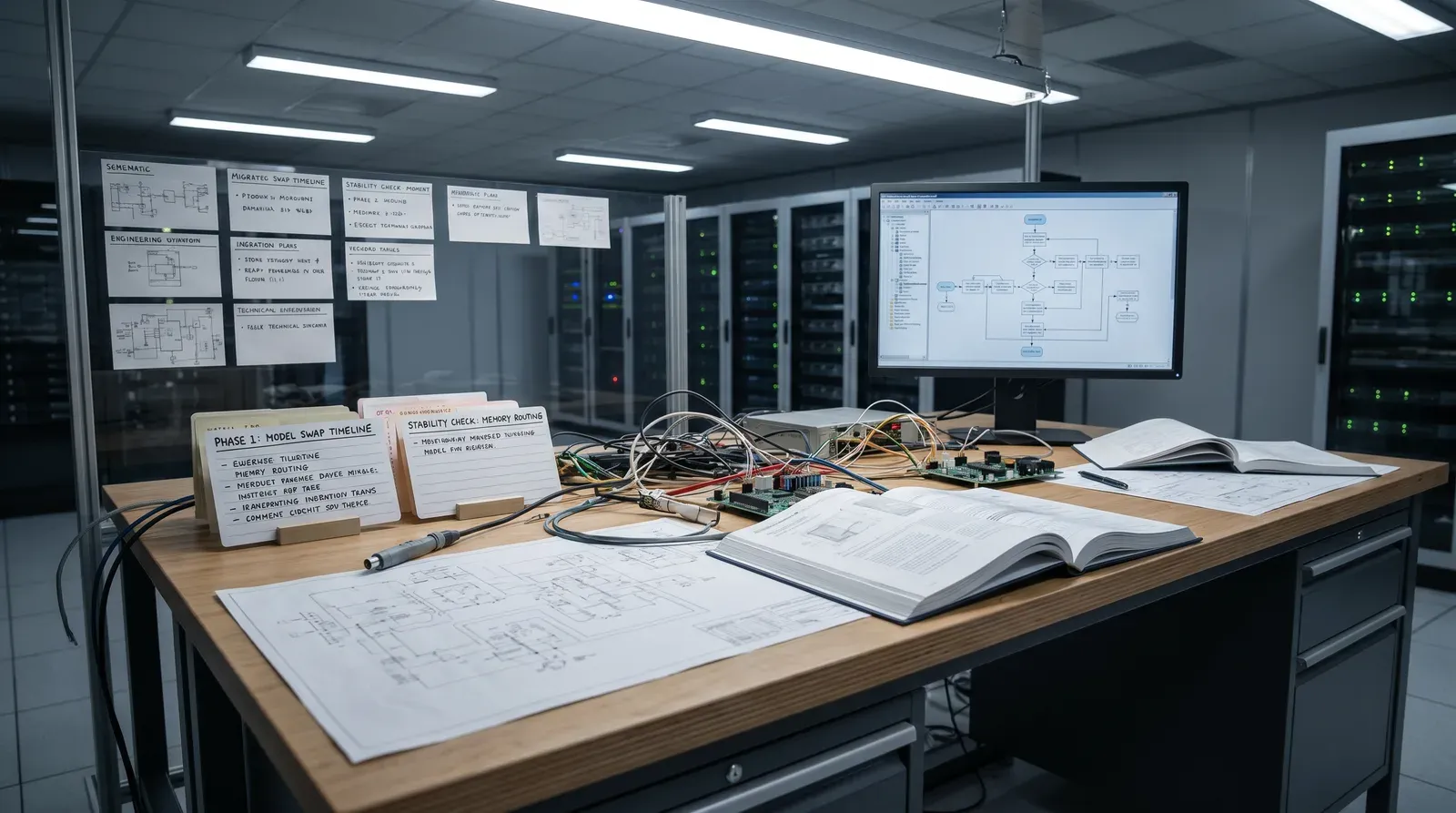
A Loop-Native AI System Keeps Growing When Models Change
The durable AI system is not the model endpoint. It is the loop that preserves state, routes work, evaluates results, and keeps learning after the backend changes.
Quick decision summary
Five plain-language checks for a go or hold decision
- What claim are we testing?
- A loop-native AI system can keep improving even when its model backend changes.
- Who is the named peer?
- Microsoft Foundry guidance on model lifecycle, retirements, and cost optimization shows that model replacement is normal operational behavior.
- Source strength
- T1 T1 (named buyer on record with primary source)
- Where this may not apply
- This argument is strongest for systems with stable tool contracts, structured memory, and measurable request paths. It is weaker for one-off chat experiments without a state layer.
- Recommended decision
- Design for replaceable models and stable loops. Keep memory, routing, and evaluation above the model layer so backend swaps do not reset the system.
The easy mistake in AI system design is to treat the model as the thing that learns.
In practice, the system learns when the loop learns.
That is a different architecture. The model is only one interchangeable part. The loop is the part that keeps the system oriented, measured, and able to improve.
Microsoft’s Foundry documentation points in that direction. It treats model lifecycle and retirement as normal operating facts. Older models get retired. Replacement models get suggested. Some deployments can enable automatic updates. In other words, the backend changes while the product is still alive.
That is exactly why loop-native design matters.
What the loop has to preserve
If a model can change without breaking the system, then the system must hold the following:
- The task definition.
- The memory of what happened before.
- The routing rule for which model gets what work.
- The evaluation rule for what counts as better.
- The stop condition when the answer is still not good enough.
If those five things live above the model layer, the system can keep growing.
If they live inside the model prompt alone, the system resets every time you swap backends.
Why this matters to operators
Many teams think model upgrade means progress. Sometimes it does. But the bigger win is when the loop makes the upgrade almost boring.
That is when the system gets durable.
The loop can absorb changes in price, context length, retirement timing, and vendor behavior because it is not built around the personality of one model. It is built around repeatable action.
The signal from Microsoft’s own guidance
Microsoft’s cost and performance guidance does not say to bet everything on one heavyweight model. It says to route, cache, batch, and use smaller models for first-pass work when appropriate.
That is a loop-native view of AI. The system learns where to spend expensive tokens and where not to.
The more that pattern spreads, the more strategic the loop becomes.
What this means for a growing AI system
A growing AI system needs three things more than it needs model worship:
- stable memory
- stable routing
- stable measurement
Those three let the system adapt without forgetting.
That is the real growth mechanism.
The model can improve. The loop can improve. But only one of them is likely to stay useful across the next product cycle.
Monday-morning move
Before approving the next AI enhancement, ask:
If we had to swap the model next month, what would survive?
If the answer is “very little,” the system is too dependent on the backend.
If the answer includes memory, routing, and evaluation, the system is already becoming loop-native.
The practical rule is simple: if the model swap would force a prompt rewrite, a routing rewrite, and a measurement rewrite at the same time, the loop is not yet holding its weight.
Draft-stage upgrade path (bounded)
To hold a compelling draft-stage verdict, this draft needs one concrete migration receipt gathered before publish lock.
- Source to fetch next: a named production team note, talk, or engineering write-up covering a real model swap.
- Quote type required: one verbatim line confirming the model changed while loop architecture remained intact.
- Metric required: one migration metric plus one post-swap quality or escalation metric.
- Owner and deadline: add this evidence packet to the weekly scan before publish-stage signoff.
If this packet is not collected, keep this article as draft-stage methodology guidance only.
Bottom line
Model replacement is not a failure mode. It is a normal condition.
A loop-native system treats that condition as expected and keeps learning anyway.
That is what makes the system compound while the model changes around it.