
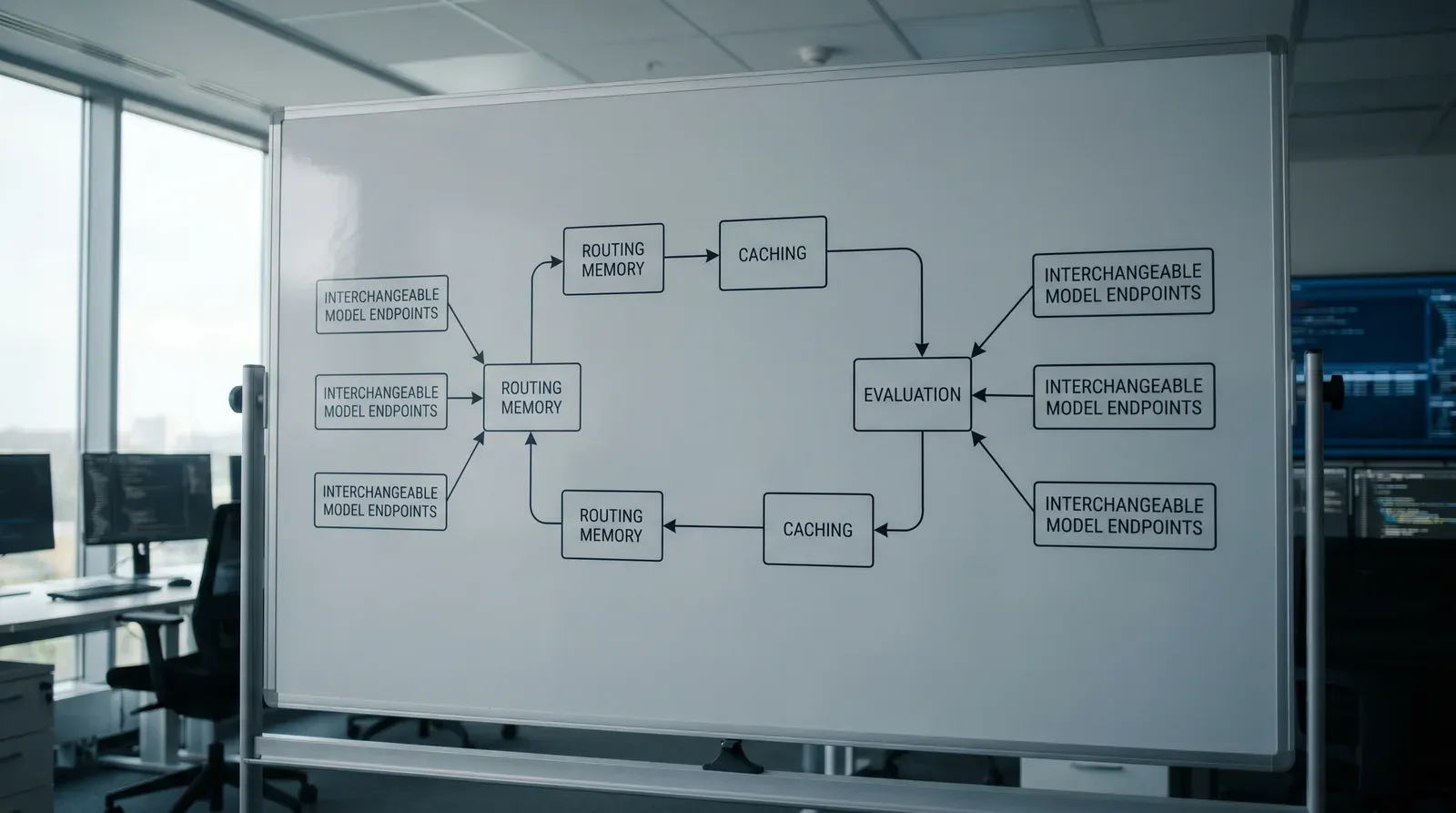
Loops Are the Moat, Not the Model
The strongest AI advantage is shifting from owning the biggest model to running the best loop. Routing, memory, caching, and measurement now do more to protect value than model size alone.
Quick decision summary
Five plain-language checks for a go or hold decision
- What claim are we testing?
- The real moat in AI is the loop around the model, not the model itself.
- Who is the named peer?
- Microsoft and Azure guidance on AI cost optimization consistently recommend routing, caching, batching, and smaller-model first-pass handling.
- Source strength
- T1 T1 (named buyer on record with primary source)
- Where this may not apply
- The loop argument is strongest where teams can instrument requests, cache repeated work, and route simple tasks away from frontier models. It is weaker in low-volume custom work where every call is unique.
- Recommended decision
- Invest in loop quality first. Hold model swaps, routing, memory, and evaluation steady enough that backend models can change without rewriting the system.
The AI market still talks about models like they are the whole product.
That framing is already too small.
This piece is an opinion grounded in current cost guidance and operator behavior, not a settled forecast.
The more durable advantage is moving into the loop around the model. The loop is the system that decides what reaches the model, what gets cached, what gets routed to a smaller model, what gets measured, and what gets remembered the next time.
That is why token cost keeps forcing the conversation forward. Once the cost of every turn is visible, the question stops being which model sounds best and becomes which system can get the same outcome with less waste.
What the loop includes
A real loop has at least four parts.
- Input control. Stable prompts, stable tools, and stable request shapes.
- Routing. Cheap models for easy work, frontier models for hard work.
- Memory. State that survives the current turn and improves the next one.
- Measurement. A way to tell whether the loop is getting better or just getting louder.
If any of those parts is missing, the model becomes a crutch. The system has no way to adapt.
Why this matters now
Microsoft’s Azure cost guidance is explicit about the pattern. It recommends caching, batching, routing, and model selection. It also says a smaller, cheaper model can handle first-pass classification or extraction, with escalation to a frontier model only when the smaller model is uncertain. Microsoft says that pattern often cuts inference cost by 60 to 80 percent without measurable quality loss on routine queries.
Other official product pages point in the same direction. OpenAI describes agent work as orchestration, tool execution, compaction, bounded output, and structured state. Google treats batch work, cached content, and lower-cost request paths as first-class product behavior. Anthropic highlights parallel subagents, effort control, and dynamic workflows as part of the model experience.
That is a loop statement disguised as a cost statement.
The savings are not coming from a single model win. They are coming from better control over the request path.
What buyers are actually funding
Most buyers do not fund model admiration. They fund a better operating loop.
They want:
- lower cost-to-serve
- better response quality on the requests that matter
- predictable behavior when volume grows
- less dependence on one expensive backend
That is why the moat moves away from the model. Models will retire. Prices will fall. New models will appear. The loop survives those changes if it is built well.
What this means for the next build cycle
The right design question is not “Which frontier model do we standardize on?”
The right question is “Which parts of the loop should be stable, and which parts should be replaceable?”
That usually means keeping these stable:
- system prompts
- tool contracts
- routing rules
- memory layout
- evaluation gates
And keeping these replaceable:
- the model endpoint
- the fallback path
- the cost tier
- the per-task specialization
That is how a system keeps growing without being trapped by the next model release.
Monday-morning move
Before the next AI budget review, ask one question for every workload:
What part of this is model-specific, and what part is loop-specific?
If the answer is mostly model-specific, the design is too brittle.
If the answer is mostly loop-specific, the system can get smarter without depending on the most expensive backend every time.
Draft-stage upgrade path (bounded)
This draft remains in the compelling draft-stage lane with one explicit buyer-evidence collection target before publish lock.
- Source to fetch next: a named platform engineering or enterprise AI operations retrospective on routing and caching changes.
- Quote type required: one verbatim quote that states loop-level controls, not model prestige, drove operating improvement.
- Metric required: one before-and-after measure pairing cost movement with quality/SLA stability.
- Owner and deadline: capture this evidence packet in the weekly scan before publish-stage review.
Absent that packet, this piece should remain draft and be framed as thesis guidance rather than settled market proof.
Opinion: If The Thesis Is Right
If the loop is the moat, the immediate consequence is not a new model race. It is a new operating standard.
Satya Nadella has helped stir this possibility by repeatedly pushing the industry to think about what compounds value around the model, not just inside it.
That does not by itself prove a market reset. It does suggest that some workloads will move closer to the user, some will stay in cloud, and some will be routed through smaller models or local machines when that is enough.
This is still a thesis, not a forecast. But it is a useful one because it changes where value accrues: from the biggest model to the best operating path.
Market signal check: real price vs launch signal
The hardware market is sending mixed evidence, and that distinction matters.
Some signals are now concrete. NVIDIA Marketplace shows DGX Spark with a public listed price. Dell has a public configured store price for Dell Pro Max with GB10.
Other signals are still pre-release. Microsoft Surface Laptop Ultra and Surface RTX Spark Dev Box pages currently read as launch signaling and notification flow, not broad public MSRP plus immediate ship clarity.
So the near-term read is straightforward: the loop-locality direction looks promising, but parts of the device wave are still early. Treat this as a moving market signal, not settled proof of a full market reset.
Bottom line
The moat is shifting from model ownership to loop quality.
The companies that win will not simply have the best model. They will have the best path from request to outcome.
That path is where cost falls, memory compounds, and performance survives model churn.
References
- Optimize cost for AI workloads on Azure
- Optimize cost for AI workloads on Azure, two-lever experiment
- Optimize model cost and performance
- From model to agent: Equipping the Responses API with a computer environment
- Batch API
- Introducing Claude Opus 4.8
- NVIDIA DGX Spark on NVIDIA Marketplace
- Dell Pro Max with GB10 product page
- Surface Laptop Ultra product page
- Surface RTX Spark Dev Box product page