

The Anatomy of AI Hype: Five Patterns That Substitute for Buyer Evidence
Five recurring patterns separate AI launch language from procurement-grade buyer evidence: authority-by-prominence, spec without economics, methodology in the footnote, vendor chorus as evidence, and future-tense outcome. An announcement scoring three or more is positioning, not buying evidence. The framework is symmetric: it scores vendor announcements and buyer announcements identically.
Quick decision summary
Five plain-language checks for a go or hold decision
- What claim are we testing?
- Five recurring patterns separate AI launch language from procurement-grade buyer evidence: authority-by-prominence, spec without economics, methodology in the footnote, vendor chorus as evidence, and future-tense outcome. An announcement scoring three or more is functionality positioning, not buying evidence, regardless of the names attached.
- Who is the named peer?
- Inductive ground from this publication so far. PwC-Anthropic alliance (May 14, 2026), KPMG-Anthropic alliance (May 19, 2026), Starbucks-NomadGo Automated Counting reversal (deployed Sept 2025, retired May 18-22, 2026; Brian Niccol on record), Microsoft and NVIDIA RTX Spark launch (May 31, 2026), OpenAI third-party eval playbook (May/June 2026). All anchored in T1 sources.
- Source strength
- T1 T1 (named buyer on record with primary source)
- Where this may not apply
- The framework is calibrated for regulated-enterprise procurement reading. It applies symmetrically to vendor announcements and to buyer announcements; the same five patterns score a CIO press release the same way they score a vendor keynote. Consumer marketing and conference theater have their own substitution patterns; this framework does not generalize there. Pilot-scale decisions under $250K may not need the full scoring discipline.
- Recommended decision
- Treat any AI announcement scoring three or more patterns as functionality evidence only. Authorize bounded pilots; decline fleet substitution, capex commitments, or program-level funding decisions. Re-score when the named target closes the absence audit. Track the upgrade or non-upgrade publicly.
Why this article exists
This publication’s tagline is AI hype is loud. AI adoption is silent. That phrase is doing more work than the typography suggests. It assumes that AI hype has a knowable shape, recurring enough to be named, recurring enough that a delivery owner can learn to read it in real time without waiting for the post-mortem.
After two weeks of audits across vendor alliances, buyer announcements, named reversals, and architecture launches, the assumption has earned a structural test. The same five patterns keep showing up in the loud half of the work. This article names them, defines the framework, and stakes the publication on it.
The framework that follows is the publication’s foundational read. Future articles will apply it case by case. When the application piece names a target, the framework will be the verdict. The named target will be incidental.
The five patterns
Every pattern below names a substitution. The substitution is what makes the pattern hype rather than evidence. The pattern is present when launch material puts the substitute in front of a buyer and asks the buyer to treat it as the real thing.
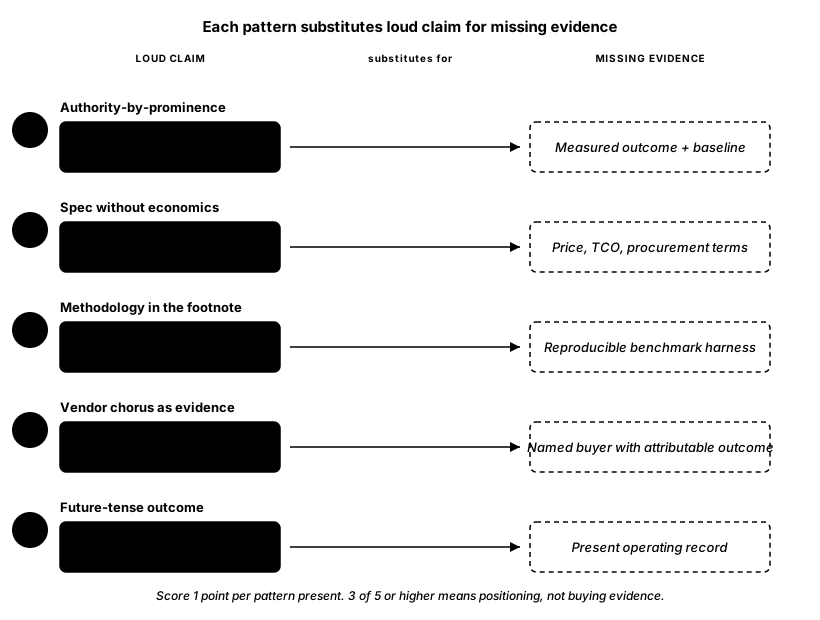
Pattern 1: Authority-by-prominence
What it looks like: A famous executive declares a categorical change in keynote language. The quote is not paired with a measured outcome, a baseline, or a falsification condition.
What it substitutes for: Prominence substitutes for evidence. The claim that the PC is being reinvented or that AI will transform professional services is the thing under audit, not the evidence for it. A founder’s confidence is a fact about the founder, not a fact about the product’s operating record.
Why it works on buyers: The cognitive cost of disagreeing with a famous executive is higher than the cognitive cost of nodding. The pattern exploits that asymmetry. The framework neutralizes it by separating who said the claim from what would prove the claim.
Pattern 2: Spec without economics
What it looks like: Performance numbers are prominently disclosed. Pricing, total cost of ownership, support-contract terms, and procurement packaging are absent.
What it substitutes for: Capability substitutes for cost. A delivery owner cannot run a substitution model against undisclosed prices. A 1-petaflop spec is not a procurement input. A per-developer-per-month line item is.
Why it works on buyers: Spec language feels measurable. It comes with units. The buyer assumes that everything else must be downstream of the spec. The buyer is wrong. Spec without price is the announcement asking for credit without offering an invoice.
Pattern 3: Methodology in the footnote
What it looks like: A headline performance number is qualified in small print by language like theoretical, internal testing, pre-release units, using sparsity, or in select scenarios. The full benchmark harness is not published: no hardware matrix, no workload scripts, no software version matrix, no scoring rubric, no confidence intervals.
What it substitutes for: An asterisk substitutes for a reproducible harness. The headline number lives above the fold; the falsification conditions live below it. The buyer reads the headline; the legal review reads the footnote. The asymmetry is intentional.
Why it works on buyers: Buyers do not read footnotes during procurement reviews. They read them during the post-mortem after the pilot under-delivered. Independent evaluation playbooks have started forcing the footnote upward (see the OpenAI eval-playbook coverage). The framework accepts only published methodology as method.
Pattern 4: Vendor chorus as evidence
What it looks like: Multiple vendor and partner executives are quoted in the announcement. The customer logo wall is present. Zero named buyer carries an attributable post-deployment outcome metric. Where named operators appear at all, the framing is forward-looking (“excited to”) not backward-looking (“achieved”).
What it substitutes for: Ecosystem chorus substitutes for buyer proof. Partners and OEMs are not buyers. They are the people whose paychecks depend on the announcement landing. A logo on a slide is not an outcome.
Why it works on buyers: The chorus simulates the social proof a real buyer roster would provide. Six vendor voices feel like more validation than one buyer voice, until the buyer asks who actually shipped what. (See the publication’s read of the PwC and Anthropic alliance, where the single named operator is the source of the only attributable operating metric in the entire announcement.)
Pattern 5: Future-tense outcome
What it looks like: The categorical claims are present tense. The capability is future tense: available this fall, later this year, Q4, general availability soon. The transformation is happening now; the evidence will be available later.
What it substitutes for: The promised future substitutes for the present operating record. By the time the product ships, the operating evidence will still need to be built from zero, against the next quarter’s funding cycle, after the current announcement has already moved markets and budgets.
Why it works on buyers: Forward-looking claims attract forward-looking decisions. Procurement committees that approve capex against future evidence rarely revisit the approval when the evidence does not land. The framework holds the line that a decision deserves the evidence that existed when the decision was made, not the evidence promised after.
The scoring rule
A target announcement gets one point per pattern present. Three of five is the threshold for the publication to treat the target as functionality positioning rather than buying evidence. Four or five of five is a strong example of the framework’s diagnostic value.
The scoring is not a verdict on the underlying product, the underlying engineering, or the underlying intent. The scoring is a read on the announcement as published. A vendor that scores 5 of 5 today can score 1 of 5 next quarter by publishing pricing, methodology, and one named buyer outcome. The framework is designed to let that movement be visible.
The framework is symmetric
The five patterns apply to vendor announcements and to buyer announcements identically. A regulated-enterprise CIO who claims program-level transformation without baseline, named workflow outcomes, and measurement-method disclosure scores the same way an NVIDIA keynote does. A consulting firm announcing AI readiness in 276,000 employees (see the KPMG-Anthropic read) without disclosing what readiness was measured against scores the same way a chip launch does.
This is the framework’s load-bearing claim. It is not anti-vendor. It is pro-disclosure. A vendor that publishes its methodology and a buyer that publishes a baseline are treated identically: as evidence. A vendor that withholds and a buyer that withholds are treated identically: as positioning.
Why this framework exists now
Two structural changes in the AI market make the framework decision-useful in 2026 specifically.
First, the gap between high-readiness and low-readiness adoption outcomes has widened to roughly 88% versus 5% in the AIRS validation sample (N=523, October-November 2025). That is the gap that funding meetings are actually about. It cannot be closed by funding more announcements; it can only be closed by funding what actually moves the customer-felt levers. Distinguishing the two is the framework’s job.
Second, the publication’s own evidence base now spans enough cases to make the patterns visible. PwC and KPMG announce alliances that disclose alliance metrics and call them buyer outcomes. Microsoft and NVIDIA announce architecture tiers that disclose spec and call it economics. Starbucks deploys a counting system across 11,000 stores and retires it after nine months, and the post-mortem reveals that the rollout claim was always functionality evidence, never substitution evidence. The patterns are not theoretical. They are inductive.
What this framework is not
The framework is not a tool to dismiss vendors. The substitution it names is between the announcement and the evidence, not between the vendor and the truth. Vendors that publish full pricing, reproducible benchmark methodology, named buyers with attributable outcomes, and present-tense availability score zero on the framework. Such announcements exist. The publication will praise them as readily as it will audit the others.
The framework is not a substitute for the CX-as-ROI funding gate (see What Counts as CX ROI Evidence Before Funding an AI Project). The two work together. Hype Anatomy screens out claims that should not reach the funding meeting; CX-as-ROI screens which claims that reach the funding meeting deserve approval. A claim can clear Hype Anatomy and still fail the three-lever audit.
The framework is not a static instrument. The five patterns are the patterns visible in the publication’s first fourteen articles. If the next forty articles surface a sixth pattern that recurs and is not reducible to the first five, the framework absorbs it. The patterns are descriptive, not axiomatic.
How the publication will use this
Three commitments anchor the framework to the publication’s operating practice.
- Application pieces will be tagged. The PURE HYPE prefix on a future article title is a public declaration that the piece is applying this framework. The article will cite the framework page directly. The reader will always know whether they are reading the framework, an application of the framework, or coverage that does not use the framework.
- Flip triggers will be honored publicly. When a named target closes the absence audit, the application piece’s verdict updates and the change appears on the /corrections page. The framework’s principled posture depends on this. A framework that scores targets without honoring upgrades is grievance, not analysis.
- The framework will be audited. Falsification triggers for this article and the PURE HYPE pipeline are explicit and time-bound. If three consecutive PURE HYPE pieces target the same vendor, if Renée’s customer-voice gate flags attack-tone risk on more than 50 percent of drafts, or if the framework fails to score real cases cleanly, the framework gets revised in public.
The Monday-morning implication
For a delivery owner reading vendor announcements between now and the next funding meeting: print the five patterns. Read every AI announcement against them. Treat any announcement scoring three or more as functionality evidence only. Authorize bounded pilots against named workload classes. Decline fleet substitution, capex commitments, and program-level funding decisions until the absence audit closes.
The discipline is not about being anti-AI. It is about being pro-evidence. The same buyers who decline to fund announcements scoring 5 of 5 will be in position to fund the ones that score 1 of 5 with confidence. The framework’s job is to make the difference legible before the budget cycle.
What would update this framework
Each item below is an event that would change the framework itself, not an application of it. The framework is a hypothesis about how AI announcements substitute for evidence. It is open to falsification.
- A recurring substitution pattern surfaces in three or more articles that the five existing patterns do not capture. The framework absorbs a sixth pattern with a defined substitution.
- A pattern fails to discriminate. If announcements scoring 5 of 5 turn out to ship operating outcomes at the same rate as announcements scoring 0 of 5 across a body of 25 or more named cases, the pattern is not load-bearing and is retired.
- The market structure shifts. If the gap between announcement language and buyer evidence closes in industry, the framework becomes decorative and is retired. The publication’s tagline updates accordingly.
Updates
- 2026-06-05: Framework introduced. Inductive ground: 14 articles published in the publication’s first three weeks of operation.
References
- PwC and Anthropic alliance expansion (Andy Crowder, Advocate Health on record)
- KPMG and Anthropic alliance (Bill Thomas, Rema Serafi on record)
- Starbucks scraps AI inventory tool across North America (CNBC)
- Microsoft Windows Experience: Introducing a powerful new chapter for Windows PCs accelerated by NVIDIA RTX Spark
- NVIDIA Newsroom: NVIDIA and Microsoft Introduce New Windows PC Class for AI Agents with RTX Spark
- What Counts as CX ROI Evidence Before Funding an AI Project (this publication)
- The Buy-or-Rent Compute Test (this publication)
- OpenAI Just Reframed Frontier AI Scores as a Setup Problem (this publication)