
AIRS finding
Articles grounded directly in AIRS research output.
What this lens looks for
The AIRS research program is Dr. Fabio Correa’s DBA dissertation on AI readiness (defended April 2026, Touro University Worldwide), now run as a longitudinal validation study. The instrument measures organizational readiness across eight factors derived from UTAUT2 with an AI Trust extension. This lens fires when a current event maps cleanly to an AIRS construct or finding and warrants the research-grounded read.
When we apply it
- A vendor or buyer move illustrates an AIRS construct in the wild (Perceived Value, Hedonic Motivation, Social Influence, Trust, etc.)
- A current debate maps to an AIRS finding that resolves it (or sharpens it)
- A canonical AIRS number is being used loosely in public discourse and needs the in-sample qualifier restored
What the verdict looks like
Articles through this lens cite the AIRS construct or finding by name, point readers to the AIRS overview for canonical numbers, and apply the in-sample qualifier rule on any statistical claim (β, p, Cohen’s d, R², ρ).
What this lens does NOT do
It does not treat AIRS as a substitute for deployment outcome evidence. AIRS measures readiness, not value capture. Articles through this lens use AIRS to frame the question, not to answer it.
Articles through this lens
-

AI Adoption Fails When Curriculum Stops at Tooling
Enterprises and graduate programs are teaching AI tool usage faster than they are teaching deployment decision quality. The result is pilot motion without durable operating gains.
-

One-Size AI Rollout Is a Hidden Execution Risk
Enterprise AI rollout plans that ignore subgroup variability create avoidable adoption failures. Treat inclusion as operating design, not as a post-launch messaging layer.
-
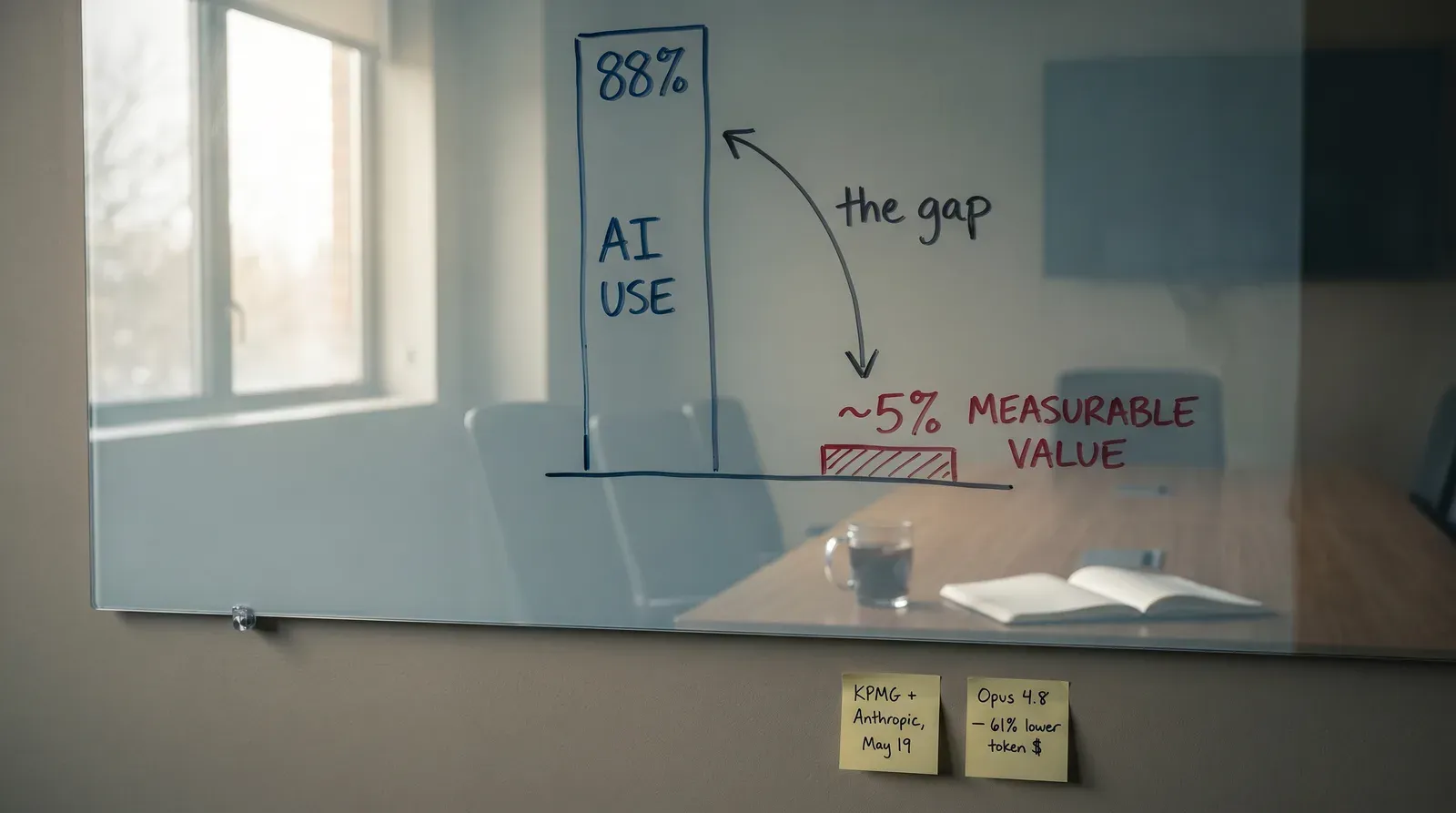
Cheaper Tokens Don't Close the Adoption-Value Gap
KPMG-Anthropic at workforce scale and Opus 4.8 at 61% lower token cost are real signals, not closure proof. The 88% vs ~5% gap lives at the outcome layer, not the input layer.