
The OpenClaw Stack Is Forming Above Microsoft and NVIDIA
A layered agent stack is separating into spec, runtime, product, and channel. The buyer question is no longer whether the stack exists. It is which parts are mature enough to observe, pilot, or scale.
Quick decision summary
Five plain-language checks for a go or hold decision
- What claim are we testing?
- The emerging OpenClaw stack means enterprise buyers can treat agent spec, runtime, product, and channel as separable procurement decisions, not one bundled platform bet.
- Who is the named peer?
- No named buyer-issued baseline-to-post deployment is published in the two provider announcements. Amgen is named by OpenAI as a customer and Sean Bruich is quoted, but only at named-partner stage.
- Source strength
- T1 T1 (named buyer on record with primary source)
- Where this may not apply
- This is provider-stage evidence. It supports architectural and procurement interpretation, not deployment outcome claims. No buyer-issued baseline-to-post metrics, no disclosed benchmark harness, no pricing comparison, and no governance process for upstream policy conformance.
- Recommended decision
- Classify each layer now: observe-only, pilot-only, or scale-approved. Freeze expansion spend on any stack where policy-conformance governance is promised but not operationally specified. Move to scale-approved only after a named buyer publishes outcome data and the policy-conformance path has a named merge authority, review SLA, and signed artifact location.
A layered open-source agent stack is forming. The important part is not that several vendors launched AI features in the same week. The important part is that the stack is separating into layers buyers can route through a committee.
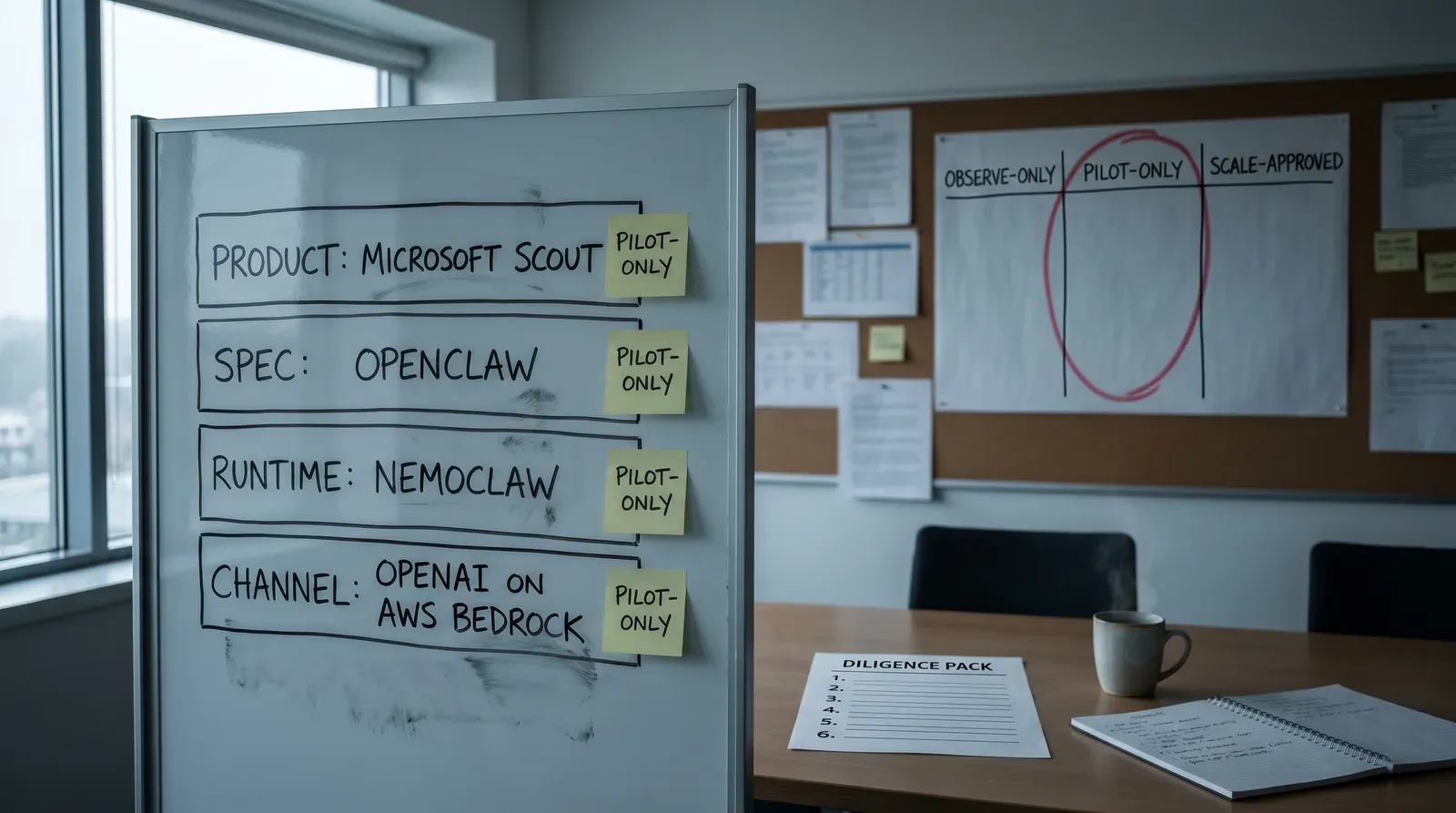
That changes the decision. Buyers no longer have to treat agent spec, runtime, product surface, and model channel as one bundled bet. They can see the layers in public. OpenClaw is the spec layer. NVIDIA NemoClaw is a runtime layer. Microsoft Scout is a product surface on top. OpenAI on AWS Bedrock is a channel and model route underneath that product discussion.
That structural read stays. What changes now is the buyer lens. Capability proof exists. Outcome proof does not.
OpenClaw matters because it is no longer just a repo. It has a canonical home at github.com/microsoft/openclaw, a Foundation at openclaw.org, and a product surface at openclaw.ai. NemoClaw matters because NVIDIA is making the runtime a separate control point. Its repo says teams can run agents like OpenClaw more securely inside NVIDIA OpenShell with managed inference. That is enough taxonomy for the buyer read. The rest of the issue is ownership, controls, and review burden.
Microsoft Scout is where that burden becomes visible. Microsoft says Scout is its first Autopilot agent, powered by OpenClaw open-source technology, and says it is contributing policy conformance directly upstream to OpenClaw. Governance ambiguity is the margin risk. License openness is not governance openness. A buyer should ask three concrete questions before treating that line as operational fact: who can merge policy-conformance changes, what SLA governs review, and where the signed conformance artifact lives once it is approved. Until those answers exist, policy conformance is a promise, not a control.
That is also why regulated buyers start with a different question than vendors do. On OpenAI’s Morgan Stanley page, David Wu, Head of Firmwide AI Product & Architecture Strategy, says, “One of the first questions we get is, is our information going to be used by OpenAI to train the public ChatGPT?” He then says, “The OpenAI team’s willingness to ensure zero data retention has been really impactful.” That is the real review sequence. Governance first. Capability second.
The OpenAI on AWS announcement makes the same split visible. OpenAI says customers can move faster from evaluation to real deployment through the AWS security, compliance, procurement, billing, and governance workflows they already use. That is a provider-issued acceleration claim. Treat it as such until a buyer publishes its own cycle-time evidence. The page does include a named operator voice from Amgen. Sean Bruich says: “Making these models available on AWS gives us an important new path to explore and scale those capabilities within the responsible AI framework, including security, governance, and operational frameworks across the enterprise.” That is the right sentence to watch because it is about operating conditions, not model theater.
It is still not deployment proof. Amgen names a path to explore and scale. It does not publish a before-and-after cycle time, control approval delta, or production outcome. No named enterprise operator is yet publicly saying OpenClaw, NemoClaw, or Microsoft Scout cleared the internal evaluation, security, and promotion-to-production review required for production use in their environment. The framework layer is ahead of the buyer-evidence layer.
That is where the second-cloud argument needs to get sharper. If the model channel moves to a second cloud, the buyer is not buying optionality for free. The buyer is buying another set of controls, another financial-governance path, and another promotion-to-production review. That can still be worth it. It is just not free.
So the Monday-morning move is not “ask harder questions.” It is to classify each layer into one of three buckets:
- Observe-only: useful to track, not ready for funded experimentation.
- Pilot-only: fund a bounded test, but keep scale money gated.
- Scale-approved: approved for broader rollout because the controls, economics, and operator evidence are in place.
For this stack today, the practical answer is clear. OpenClaw as spec is pilot-only. NemoClaw as runtime is pilot-only. Scout as product surface is pilot-only. OpenAI on AWS is pilot-only for teams that need the channel, but only after governance and cost review. None of these layers are scale-approved on the evidence currently in public.
That leads to a simple freeze rule. No expansion spend on any stack where conformance governance is promised but not operationally specified. If the vendor cannot show merge authority, review SLA, artifact location, residency controls, price curve, and exit path, the stack stays out of the scale bucket.
That is the diligence pack a committee can send this week:
- Show the policy-conformance governance model, including merge authority and review SLA.
- Show the signed audit artifact and where it is stored.
- Show residency and boundary controls by region and channel.
- Show the price curve at pilot and scaled usage, not just launch pricing.
- Show who can authorize release and rollback across the product, runtime, and spec layers.
- Show the exit path if the team wants to change runtime, cloud channel, or product surface later.
That is the actual read on this week. The stack is real. The governance path is not yet mature enough to erase committee friction. Capability proof exists. Outcome proof does not. Until a named buyer publishes cycle-time or production evidence, and until policy conformance becomes an auditable operating process rather than a line in an announcement, this remains a sharp architectural signal and a controlled procurement experiment, not a scale decision.